
Finding vanity numbers local to your market comes down to four moves. Pick the area code and pattern that fit your customers, search an inventory filtered by that area code, compare prices and buy a number with a fixed price, then port it to your carrier or VoIP provider. Most transfers finish in 4 to 10 business days, and the transfer is usually the slowest part of the whole process.
The hard part is not the idea. It is the search. Type "local vanity phone numbers near me" into Google and you get number generators, toll-free pages, and brokers with unclear pricing. You still do not know whether your area code is available, what a fair price looks like, or how a number you buy ends up ringing on your phone. A random 10-digit number costs you recall every time you advertise, so the details are worth getting right.
This guide walks you through each step in order, with real prices and a worked cost example. We run Numoreé, a marketplace for premium local and toll-free numbers founded in 2015, so the steps below reflect how buying and porting a number actually works.
Why a local vanity number is worth buying
A local vanity number is a regular 10-digit phone number with a geographic area code, chosen because it is easy to remember. Before you start the steps, it helps to know what the number is, how it differs from toll-free, and what you pay for it.
What counts as a local vanity number
A local vanity number is an ordinary number (area code, three digits, four digits) picked for memorability. It comes in two forms. Word numbers map letters to keypad digits, such as your area code followed by PLUMBER. Pattern numbers repeat or sequence digits, such as 201-308-1111, and need no spelling at all.
Either form works on every phone and routes like any other number. The "vanity" part lives in your customer's memory. Because the number carries a local area code, callers read it as a business nearby rather than a distant call center.
A local vanity number is a normal phone number that customers can recall without writing it down.
Local or toll-free
Choose a local number when customers pick you for proximity, and a toll-free number when you sell across the country. Many businesses hold both. This guide focuses on local numbers, though Numoreé sells toll-free vanity numbers too.
| Local vanity number | Toll-free vanity number
Prefix | A geographic area code, such as 201 or 310 | 800, 888, 877, 866, 855, 844, 833
What callers infer | A nearby business in their community | A larger company with wider reach
Best for | Contractors, shops, clinics, agents, firms with a defined territory | Businesses serving customers nationwide
The two costs you pay
You pay for a local vanity number in two ways. The first is a one-time acquisition price for the number itself. The second is the monthly service fee from the carrier or VoIP provider that carries your calls. At Numoreé the purchase price is the one-time cost, and your carrier may charge separately for service.
The one-time price depends on where the number comes from.
Source | Typical one-time cost | The catch
Number bundled with a phone plan | Often included or a small add-on | Rarely memorable, usually a clumsy letter mix
Marketplace with patterned numbers | Low hundreds to about $2,000 (Numoreé listings run $249 to $1,995) | You still need a carrier to port it into
Highly sought-after words and short patterns | Can reach thousands | Often has to be brokered
Budget for two costs: the number once, and the phone service every month.
Step 1. Pick your area code and pattern
Start with the area code your customers dial from, then choose between a word and a repeating pattern. Settle both before you search, because search tools filter on these two inputs.
Choose the area code customers recognize
Pick the area code that matches where your customers live, not where your office happens to sit. A contractor who covers a whole metro area should look at the codes most residents carry, including any overlay codes. An overlay code is a second area code assigned to the same geography, so it still reads as local.
If you are searching for local vanity phone numbers near you, widen the net one step at a time. Filter by your city first, then by your state. With a VoIP provider you can usually answer calls from anywhere, so you may not need to be physically in the area code. Confirm that with your provider before you buy.
Choose the area code your customers live in, because that is the one they will trust.
Decide between a word and a pattern
Word numbers work when your trade has a short, obvious term. A local number leaves seven characters after the area code, so PLUMBER fits exactly. The letters map to keypad digits like this.
2 | 3 | 4 | 5 | 6 | 7 | 8 | 9
ABC | DEF | GHI | JKL | MNO | PQRS | TUV | WXYZ
PLUMBER becomes 758-6237, so your area code followed by PLUMBER dials correctly. A word longer than seven letters will not fit.
Pattern numbers skip spelling entirely. Repeated last four digits like 1111, 5555 or 9999 are easy to say over the phone, easy to read on a truck, and hard to mishear in a radio spot. Some buyers favor 8888 because the pattern is considered lucky. Numoreé's default view shows numbers whose last four digits repeat, and a keyword search handles the word side.
Run the say-it-out-loud test
Before you shortlist, put each candidate through a quick check. A number that fails any of these will cost you calls.
- Read it aloud to someone who has not seen it. Can they write it down correctly on the first try?
- Avoid words with alternate spellings, such as CLEAN versus KLEEN.
- Look at the digits behind the letters, and make sure they do not read as something unintended.
- Write the full number in the format you will print on signs and vehicles.
- Keep three to five backups, because your first choice may already be taken.
Step 2. Search and check availability
Search an inventory that filters by area code, city, state, and keyword, then confirm the number is actually for sale before you plan around it. A local vanity number search is only useful if the results are numbers you can buy.
Search by area code, city, or state
On Numoreé you can search the whole US with the search filter, narrow by state, or browse the Explore By State section. Each listing shows the full number, area code, city, and state along with a fixed price. You can also search by keyword or browse vanity numbers by category.
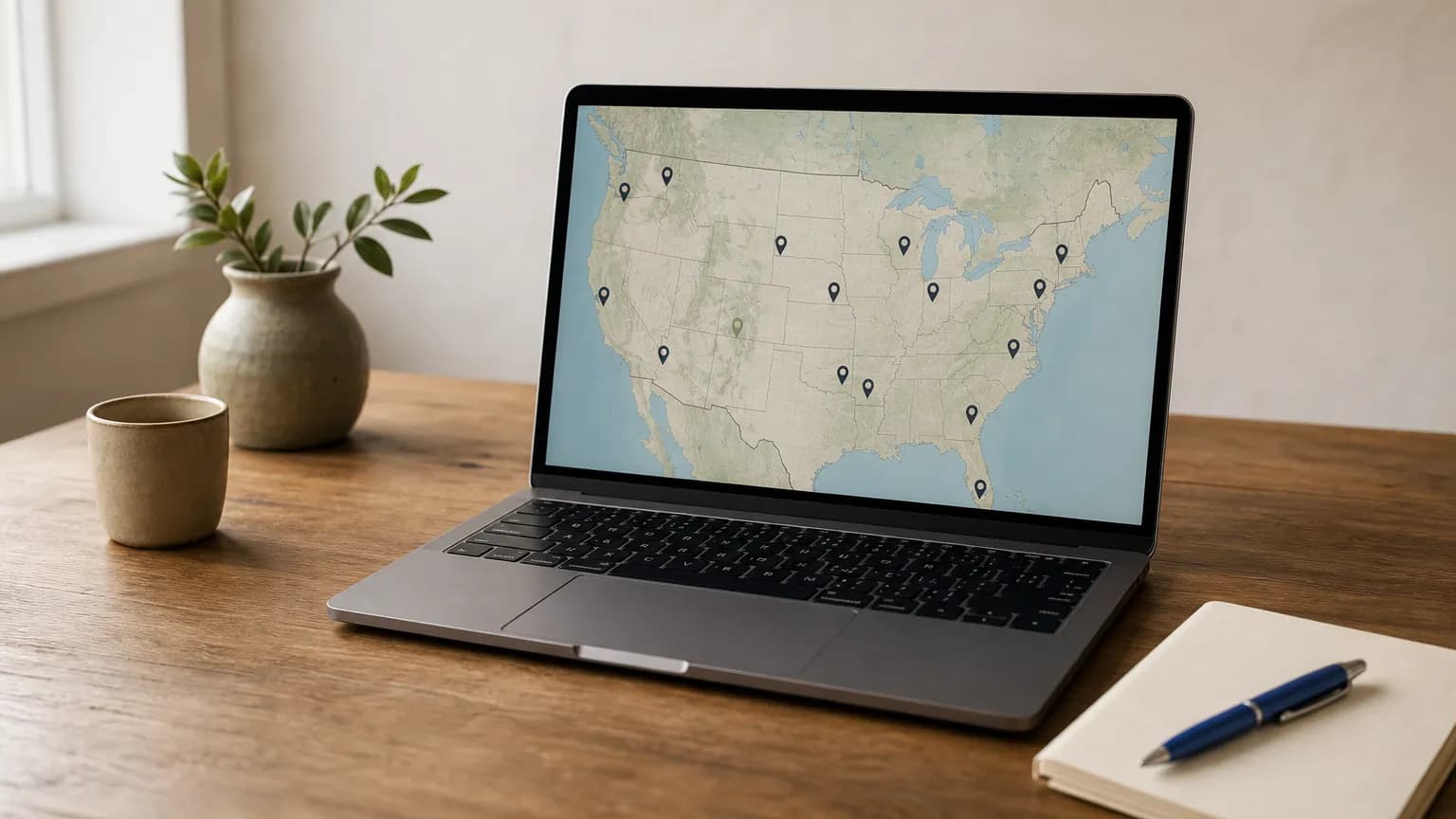
The default view shows numbers whose last four digits repeat. If you want word numbers or other patterns, use Show all numbers to remove that filter. Then work through your shortlist from Step 1, starting with your exact area code and moving to neighboring or overlay codes.
Search by area code first, then widen to the state, so you see every local option before you compromise.
Confirm a number is available
A listing with a price and a Buy Now button is a number offered for sale. If you want to confirm a number or ask about one you saw elsewhere, Numoreé support handles availability checks. Do this before you tell your designer or printer anything.
Check availability the same way no matter where you search. Provider search tools only cover that provider's own inventory, so one empty result does not mean the number does not exist. A marketplace with a larger inventory gives you more chances to find a match.
What to do when your number is taken
Taken numbers are normal, especially for common words. Work through these fallbacks in order.
- Swap the last four digits for a different repeating pattern.
- Try a neighboring or overlay area code that your customers also recognize.
- Shorten the word, or pick a synonym from your backup list.
- Ask for brokerage help. The Numoreé team can locate and negotiate premium numbers that are not currently listed.
If your first-choice number is gone, change the pattern or the area code before you change the brand.
Step 3. Compare prices and buy
Compare what local vanity numbers for sale cost against your budget, then buy at the fixed price and confirm that your carrier can accept the transfer. Pricing is the step where most buyers overpay or stall, so work it out before you click.
What local vanity numbers for sale cost
Price follows pattern, scarcity, and the rest of the number. Numoreé's listings run from $249 to $1,995. Repeated digits like 1111, 2222, 3333 and 9999 usually cost less. Patterns like 4444, 6666, 8888 and 0000 usually cost more. These sample listings show the spread.
Number | Location | Price
201-267-2222 | Oradell, New Jersey | $249
201-298-9999 | Hasbrouck Heights, New Jersey | $249
201-308-1111 | Rochelle Park, New Jersey | $249
201-335-4444 | Rochelle Park, New Jersey | $349
201-298-0000 | Hasbrouck Heights, New Jersey | $995
201-201-4444 | Jersey City, New Jersey | $1,995
The last row shows that the rest of the number matters too. Its area code repeats in the middle digits, which makes it far more distinctive than a typical 4444 number.
A worked cost example
Say you run a plumbing company and choose 201-308-1111 at $249. Your carrier or VoIP plan is a separate cost. As a hypothetical, assume $20 per month, so $240 over twelve months. Your first-year total is $249 plus $240, or $489.
Now compare the top of the range. A $1,995 number with the same plan totals $2,235 in year one. The monthly fee is the same for both, so the premium goes only to the number. Ask whether the extra memorability will earn back that difference across your advertising.
Buy with these checks done
Complete checkout once your number and your carrier are settled. Numoreé accepts major credit cards and other secure payment methods, and processes transactions through encrypted connections.
Run through this list before you pay.
- Confirm the exact digits and area code.
- Confirm your carrier or VoIP provider accepts ported-in numbers.
- Remember that refunds are generally not offered once a transfer has begun.
- Keep your payment confirmation in case you need support.
Check the digits and your carrier before you pay, because a transfer in progress is generally not refundable.
Step 4. Transfer the number and set it up
After payment, Numoreé starts the transfer, and you hand the transfer details to your carrier, which brings the number into your account. Expect 4 to 10 business days, depending on the carrier and number type. This is how a bought local vanity number ends up on your phone.
What happens after you pay
Numoreé begins the transfer process once payment is received. It then emails you the account number, transfer PIN, service address, and porting instructions your carrier needs. Follow these steps in order.
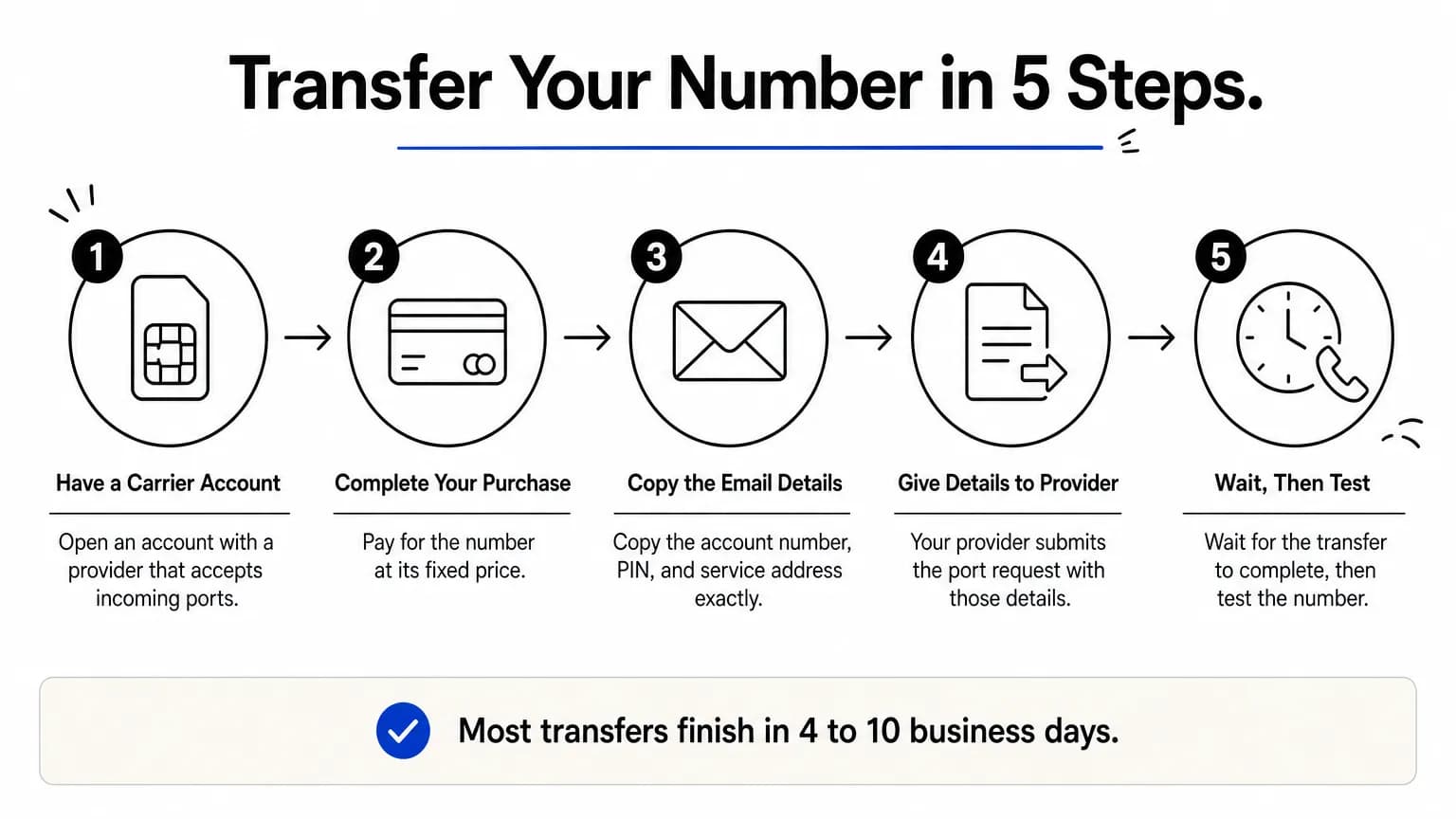
- Have an active account with a carrier or VoIP provider that accepts incoming ports.
- Complete your purchase.
- Open the email and copy the account number, PIN, and service address exactly.
- Give those details to your provider so it can submit the port request.
- Wait for the transfer to complete, then test the number.
Keep service active and know the timeline
Most transfers finish within 4 to 10 business days. The wait depends on the carrier receiving the number and on the type of number. Do not cancel or change your new provider account while the port is pending. Mismatched details are the usual reason ports stall, so enter the information exactly as emailed.
Numoreé's team helps with transfer and setup questions after purchase. Once the transfer completes, the number belongs to your telecommunications account and stays under your control, subject to carrier regulations.
Set it up and put it to work
Set up the number before you advertise it. In your provider's dashboard, configure call forwarding to your cell or office line, record a voicemail greeting, and set business hours if you want after-hours routing. Then call the number from a different phone and confirm it rings where you expect. Ask your provider whether the number supports texting, because that varies by provider and number type.
Next, put the number everywhere customers look. Update your website header, your Google Business Profile, invoices, email signature, vehicle wraps, and signage. Keep your old number forwarding to the new line for a while, so existing customers do not hit a dead end.
Test the number from another phone before you print it anywhere.
Your next move
A good local vanity number takes four decisions: the area code, the pattern, the price you will pay, and the carrier that will carry it. Choose the area code your customers live in, test your shortlist out loud, buy at a fixed price, and give your carrier the transfer details exactly as sent. The process is short, and the number lasts for as long as you keep your account.
If you want to see what is available in your area code, search local vanity numbers by area code, city, or state and shortlist a few that pass the say-it-out-loud test. If your number is not listed, ask the team about brokerage and let them track it down.